
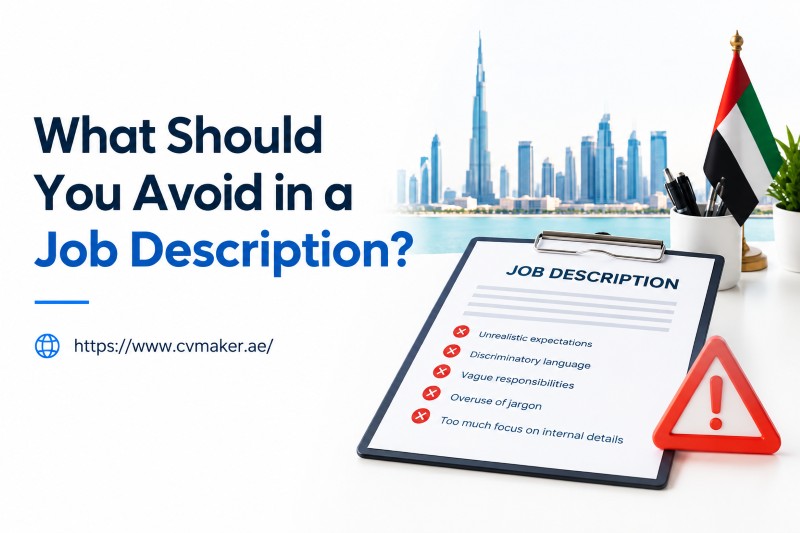
What Should You Avoid in a Job Description?
Looking to get hired for your desired job? Well! It requires more than just meeting its requirements. You should know exactly what the employer will be looking for before applying for the position. The description of a job reveals the duties that will be performed, the skills that will be needed and all the other important information about the vacancy.
Nevertheless, not all the requirements are important for the applicant. Some of them are important, and some are preferred but not required. Thus, reading the job description can help the person to exclude unqualified applications. Let’s discuss further.
What to Look for First in Your Job Description?
Firstly, you need to understand the nature of the job. Sometimes just the job title may not be very helpful in understanding the nature of the job, especially if organisations give different names to similar jobs. You should look for:
- The main purpose of the role
- Key responsibilities
- Required qualifications
- Required experience
- Technical or professional skills
- Working hours and location
- Salary and benefits, where provided
- Any specific eligibility requirements
The most important issue here is whether or not you can clearly understand what you will really be doing in case you get hired. If not, then spend some time researching the employer and position you’re applying for.
How Can You Tell Which Job Requirements Matter Most?
Job descriptions often contain a mixture of essential and preferred requirements. Understanding the difference can stop you from rejecting yourself too early.
Separate Essential Requirements from Preferred Skills
An employer may state that a particular qualification or level of experience is required. Other skills may be described using terms such as:
- Preferred
- Desirable
- Advantageous
- A plus
- Preferred but not essential
These terms usually indicate that the employer would like to see the skill but may consider candidates without it. Consider the requirements which are directly linked to performing the task.
Should You Apply If You Don’t Meet Every Requirement?
You don’t have to meet every mentioned requirement in a job description. Usually, employers describe an ideal candidate instead of describing a person who has all the mentioned requirements. Instead, ask yourself:
- Do you have the core experience needed for the role?
- Can you perform the main responsibilities?
- Do you meet the essential qualifications?
- Can your existing skills transfer to this position?
- Are the missing requirements essential or simply preferred?
If you can perform the core duties and meet the main requirements, the vacancy may still be relevant. This is where a specialised CV can come into play as well. Instead of attaching the same resume to every employer, make sure your mentioned experiences are relevant to the stuff mentioned in the job posting.
What Are Red Flags in a Job Description?
An unclear job description does not automatically mean the employer is unsuitable, but it can be a reason to investigate further. Pay attention when:
- Responsibilities are extremely vague
- The role appears to cover several unrelated positions
- Essential requirements are excessive or unrealistic
- The salary or employment terms are unclear
- The job description contains contradictory information
- The employer provides very little information about the position
- The vacancy uses exaggerated language instead of explaining the actual work
Phrases such as manage various tasks or support business activities as required do not tell you much about your expected responsibilities. A clear vacancy should give you enough information to understand the position before you invest time in an application.
Should You Pay Attention to Salary and Benefits?
Yes. Salary and benefits can help you decide whether a vacancy matches your expectations before you apply. When salary information is available, check:
- Whether a salary range is provided
- Whether the amount is monthly or annual
- Whether benefits are mentioned separately
- Whether commissions or bonuses are included
- Whether accommodation, transport or other allowances are offered
- Whether the working hours are clearly stated
Some employers do not disclose salaries, which does not necessarily mean that the job is not suitable. Nevertheless, knowing about the entire employment package will assist in making a more well-informed choice.
Candidates who want professional support can also work with Gulf CV resume helpers to make their applications more focused on the requirements of Gulf employers. The goal is not to copy the job description into your CV. Instead, use it to identify which genuine skills and achievements from your background deserve attention.
How to Handle Unclear or Unnecessary Requirements?
There could be some requirements in the job description that do not necessarily have anything to do with the job itself or are vague and unclear. There could be some general statements in the description regarding what kind of employee they are looking for.
Do not think that every statement is equally important. If the requirement is unclear, check if there is a connection between the requirement and the duties of the job. For instance, if the job requires evening shift work, then the working hours requirement has something to do with the job.
If there is a statement on some irrelevant personal characteristic, ask yourself if you need to know why it has been stated. Remember that the employment laws in different countries might vary.
What Should You Do Before Sending Your Application?
Once you understand the job description, compare it with your CV before applying. Check whether your CV clearly shows:
- Relevant work experience
- Skills mentioned in the vacancy
- Relevant qualifications
- Measurable achievements where possible
- Industry-specific knowledge
- Software or technical skills required for the role
Remove unrelated information where it takes attention away from your relevant experience. For candidates looking to apply in Abu Dhabi, professional guidance from a Resume Writing Company in Abu Dhabi can also assist in presenting their experience in an organised CV.
Readers Usually Ask
Do you need to apply even if you lack some requirements?
Yes, but only if you satisfy major requirements and can fulfil core responsibilities. It is especially important to determine whether the absent requirements are essential or optional.
How will you know that a job description is vague?
A job description will be vague when it fails to give proper information on responsibilities, skills or requirements for you to have a clear idea about the vacancy.
Do you need to adapt my CV to each job?
Adapting your CV might help recruiters find more easily your experience and skills. It is important to use only those skills and experience that correspond to a vacancy and not add unnecessary skills.
What if there are some unrealistic requirements?
Determine which of the requirements are really essential. In case there are unusual requirements or unusual qualifications and responsibilities required from a candidate, investigate the employer and check whether this position corresponds to your career plans.
Can a job description help me prepare for an interview?
Yes. The responsibilities and requirements can show you which areas the employer is likely to discuss. Use them to prepare examples from your previous experience that demonstrate relevant skills.
To Conclude!
A job description is not only a list of requirements. It is also a great source of valuable information for a job seeker regarding what an employer is looking for, how the job will be structured, and which parts of your experience you need to highlight in your application. Analyse the requirements, distinguish between mandatory requirements and desired skills, and research any unclear points. Use this information to prepare your CV that will showcase your real experience. This way, a Gulf job seeker will be able to organise their application process effectively and target positions according to their real skills and experience.